In short
- Matcha’s green comes from chlorophyll, which breaks down into brownish-green compounds under light, heat and oxygen.
- The decline is measurable from around the second month of storage and speeds up from the sixth month.
- Opaque, airtight packaging kept cold and out of the light slows this down; glass and paper in daylight are the worst combination.
- Color and flavor degrade for related but separate reasons, so a matcha can dull in color before it tastes noticeably different, or the reverse.
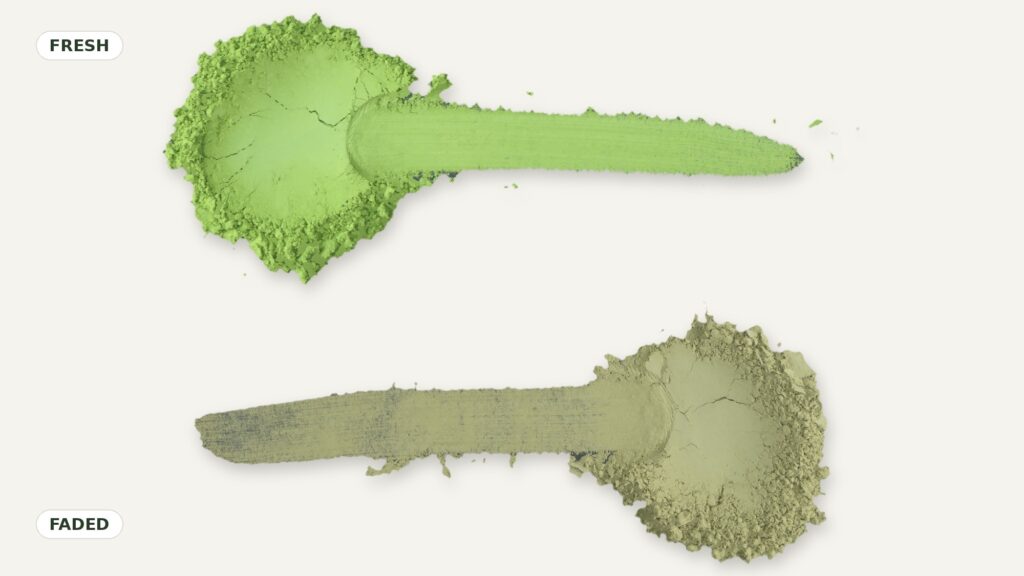
A vivid green matcha and a dull, olive-yellow one aren’t just a matter of taste in photography. The color difference is a real chemical change, and knowing what causes it is what makes storage advice make sense, rather than just something you’re told to follow.
What’s actually breaking down
Matcha’s color comes mainly from chlorophyll, the same pigment that colors most green plants. During tea processing, this and related pigments are broken down by light, oxygen and heat into pheophytin and other derivatives, which read as a duller, brownish-olive rather than the bright green of intact chlorophyll.1 A 2024 study of tencha drying found the same pattern happening during processing itself: even though the initial steaming step deactivates the enzyme that would otherwise break chlorophyll down enzymatically, heat alone still degrades it, and the degree of change varies with drying temperature and time.1 That study also notes that color is treated as a serious quality marker in its own right: in Chinese national standards it’s given as much as 40% of a matcha’s sensory score.1
Why matcha is especially vulnerable
Matcha isn’t just green tea that happens to be a powder. Grinding tencha leaf into matcha creates an enormous amount of surface area compared to whole or cut tea leaves, and that surface is what’s exposed to air and moisture. A patent filing on green tea processing describes this plainly: finely powdered green tea is more vulnerable to oxidation and absorbs moisture more readily than leaf tea, purely because of how much more surface area is exposed once it’s ground down.2 That’s a structural reason matcha needs more careful handling than a bag of loose-leaf sencha, independent of how good the leaf was to begin with.
A timeline worth knowing
A study using chlorophyll level as a freshness indicator in green tea found the decline wasn’t instant or linear: a measurable drop showed up in some samples from as early as the second month of storage, and by the sixth month, the decline was consistent across every sample tested.3 The same study compared packaging types directly, and found metal and other opaque packaging preserved chlorophyll far better than glass or paper stored in daylight, which came out worst.3
This was measured in green tea generally, not matcha specifically. Given how much more surface area matcha exposes once ground, it’s reasonable to expect the same pattern to apply at least as strongly to matcha, but the exact timeline for a ground, food-use matcha hasn’t been separately confirmed in what we found. Treat the two-month and six-month marks as a general guide, not an exact countdown for your own product.
Color and flavor aren’t the same story
It’s tempting to treat a faded matcha as simply “gone off” across the board, but color and taste come from different compounds, degrading by different routes, and don’t necessarily move together. A recent review of how matcha behaves during food processing treats chlorophyll loss, catechin degradation and L-theanine (the amino acid behind matcha’s characteristic sweetness and umami) stability as related but separate trade-offs, each affected by heat and storage at its own rate.4 In practice, that means a matcha can dull in color before its flavor noticeably changes, or the reverse; color is a useful early warning, not a complete readout of freshness.
What this means in practice
- Keep it sealed. Every accelerant here, oxygen, moisture and (to an extent) light exposure, gets worse the longer a container sits open. Reseal promptly and press out excess air where you can.
- Keep it dark. An opaque tin or a foil-lined pouch beats a clear jar on a shelf, for the same reason glass performed worst in the packaging comparison above.
- Keep it cool. Heat accelerates the same chemistry that light and oxygen drive, so storage away from ovens, direct sun or a hot kitchen counter matters.
- Use it in a reasonable window. Given a measurable decline from around two months and a sharper one from six, buying in quantities you’ll use within a few months is a simple way to stay ahead of the curve, rather than managing decline after the fact.
References
- ScienceDirect / Food Chemistry Advances, 2024. Effect of different drying temperature settings on the color characteristics of Tencha. sciencedirect.com
- US Patent filing. Green tea composition and moulding matter thereof, and process for producing them (background section on powdered green tea oxidation). image-ppubs.uspto.gov
- ResearchGate. Chlorophyll as an indicator of green tea quality (storage duration and packaging comparison). researchgate.net
- PMC (National Institutes of Health). Beyond composition: processing-driven transformations and functional trade-offs of matcha tea in foods. ncbi.nlm.nih.gov
Get new articles by email
One email when we publish. Research summaries and tasting notes, with sources.